
What is an order cycle?
The order cycle is the end-to-end process that moves an order from placement to delivery, and order cycle time is the metric that measures how many days that process takes. It gives operations teams a single view of everything that happens between a click and a doorstep.
Most order cycles move through four broad stages: order placement, order processing, order fulfillment, and delivery. Teams map the cycle so they can see exactly where time and errors pile up at each handoff.
A tight order cycle protects customer satisfaction, steadies cash flow, and earns repeat purchases. A February 2025 McKinsey e-commerce delivery survey of more than 1,000 US consumers found 90% are willing to wait two or three days for delivery, provided shipping is free.
Key characteristics
- Four stages: the cycle runs through order placement, order processing, order fulfillment, and delivery, and any one of them can slow the whole thing down.
- Measured as order cycle time: the elapsed days between order placement and customer delivery, often split into source, make, and deliver time.
- The cross-industry median customer order cycle time is 12.0 days between order placement and delivery, per APQC order cycle time benchmark drawn from nearly 12,000 companies.
- Doubles as a review cycle: in inventory management, the order cycle also sets how often stock is reviewed and reordered, tied to reorder points and safety stock.
- Driven by fundamentals: inventory accuracy, supplier lead times, and automation shape the total order cycle time.
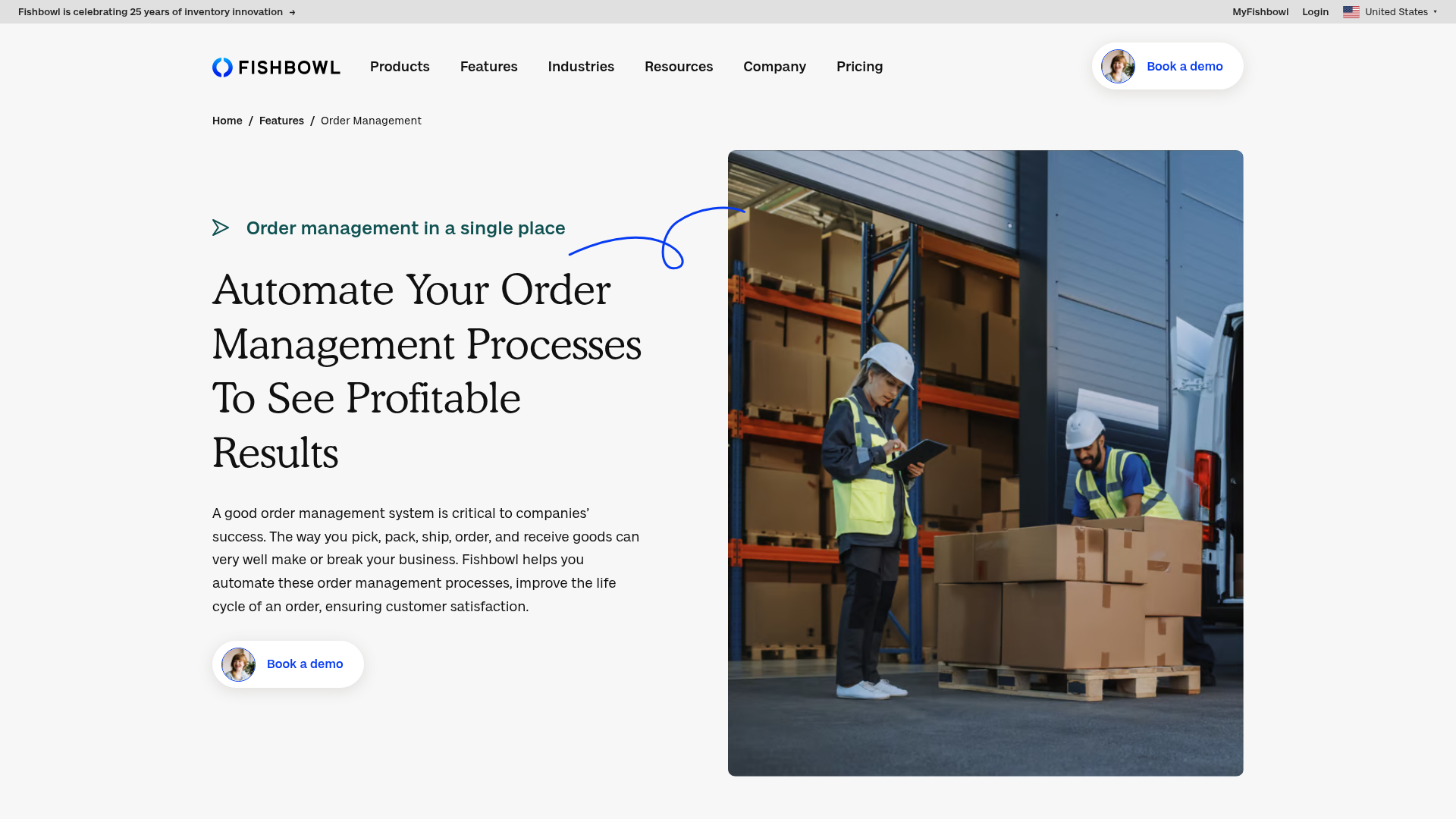
Fishbowl’s order management tools automate the pick, pack, and ship stages of the order cycle. Source: Fishbowl order management features.
Example
Grill Works Inc., a manufacturer in Marshall, Minnesota, cut its order cycle times to an average of 3.9 days using Fishbowl. A customer order enters at placement, moves through sales order processing, gets picked and packed during fulfillment, and then ships and is delivered.
Speed carries weight at checkout, too. Baymard cart abandonment research updated in September 2025 found that among shoppers with genuine purchase intent, 20% abandoned their cart because delivery was too slow.
Related terms
FAQ
What is order cycle time?
Order cycle time is the elapsed time between order placement and delivery, the measurable key performance indicator (KPI) version of the order cycle.
What is the difference between order cycle time and lead time?
Order cycle time is measured from the customer’s order to their delivery, while lead time usually refers to the supplier side, meaning how long replenishment stock takes to arrive.
How can a business shorten its order cycle?
Improve inventory accuracy, automate order processing, and keep real-time visibility across the operation. Supply chain coordination failures, a key driver of order cycle delays, account for an estimated $298 billion in annual losses globally, per IHL Group inventory research (IHL Group, 2026).
Fishbowl brings order execution and inventory into one system so your team can watch the cycle in real time and tighten it. Book a demo to see how it fits your workflow.