
What is safety stock?
Safety stock is the extra inventory you keep in reserve for the days when demand runs hot or a shipment shows up late. It sits on top of your regular working inventory as a financial and operational cushion.
It is easy to confuse with cycle stock, so keep the two separate. Cycle stock covers normal, predictable demand between deliveries, while safety stock is the additional cushion you hold on top for the unpredictable part.
Getting this buffer right protects both revenue and customer trust. Out-of-stocks (empty shelves) account for $690.9 billion of inventory distortion, 65.6% of the total, according to IHL Group’s 2026 Inventory Distortion Study.
Key characteristics
- A buffer, not routine stock: Safety stock sits on top of cycle stock and is meant for emergencies like demand surges or late deliveries, not everyday order fulfillment.
- Sized from three inputs: The safety stock formula draws on your target service level, demand variability, and lead-time variability.
- Feeds the reorder point: Your buffer is one input to the reorder point calculation, the level that triggers a new order.
- A deliberate trade-off: Hold too little and you lose sales; hold too much and carrying costs climb. In U.S. food retail, consumers reported a 9.5% out-of-stock rate in 2024, according to Purdue University’s Center for Food Demand Analysis and Sustainability.
- Not static: Review the number regularly, because demand, seasonality, and supplier reliability all shift over time.
Example
Picture a snow shovel maker heading into winter, when a single cold snap can empty the warehouse. To size its buffer, it uses the standard formula:
Safety stock = (maximum daily sales x maximum lead time) – (average daily sales x average lead time)
With maximum daily sales of 100 units, a maximum lead time of 7 days, average daily sales of 60 units, and an average lead time of 5 days, the math is (100 x 7) – (60 x 5) = 400 units. That 400-unit cushion carries the shovel maker through a spike while it waits on the next resupply.
Fishbowl can calculate and maintain a number like this automatically as your sales and lead times change. That kind of built-in discipline pays off: Hodo Foods, a plant-based food producer, saw a 35% reduction in stockouts with Fishbowl. For more on preventing stockouts, a well-tuned buffer is where most teams start.
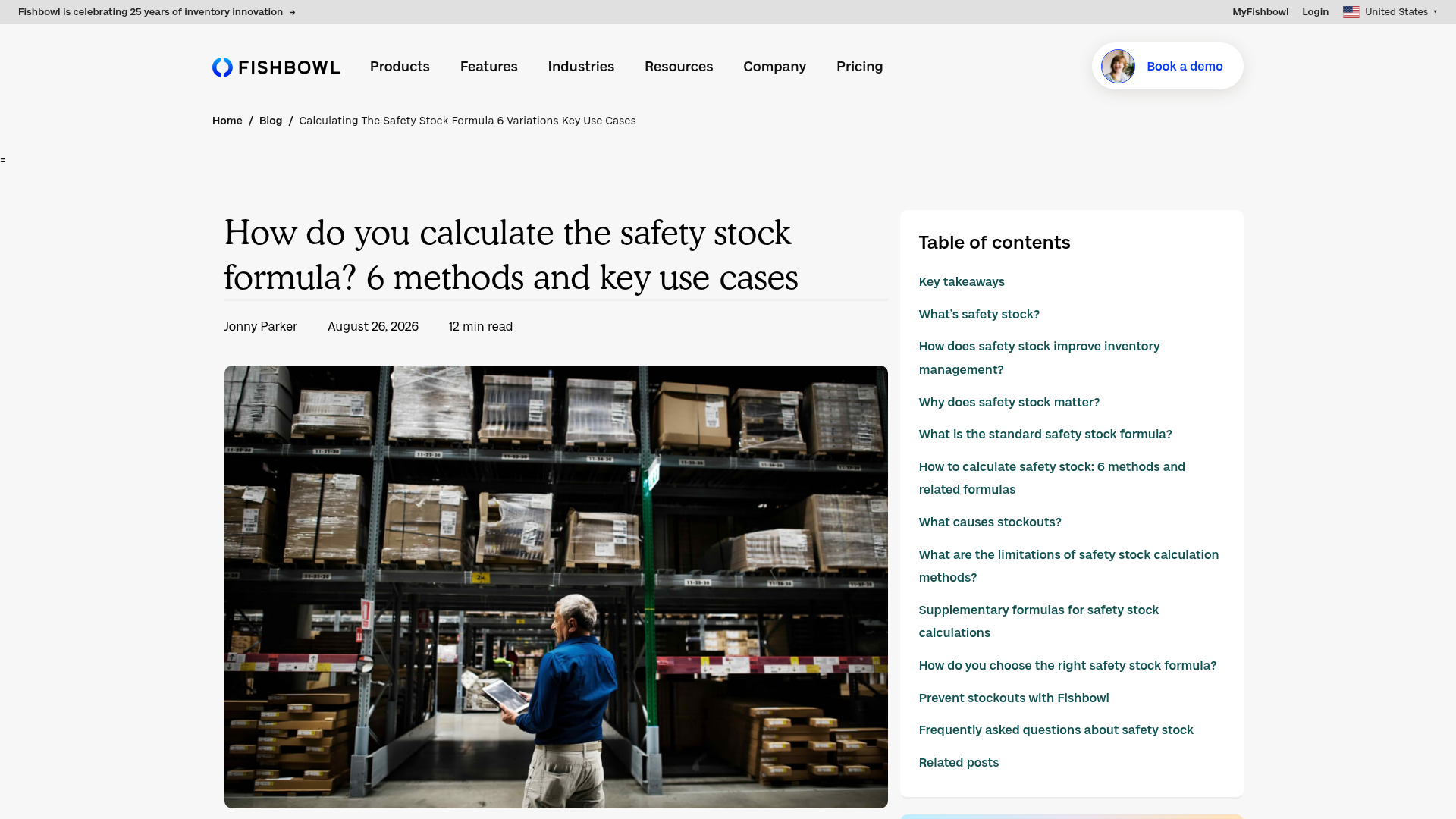
Fishbowl’s safety stock formula guide walks through six ways to size buffer inventory. Source: Fishbowl blog.
Related terms
- Inventory management terms: a glossary of core terms, including cycle stock and the reorder point.
- Economic order quantity: the order size that minimizes total ordering and holding costs.
- Stock replenishment: the process of refilling inventory as it sells down.
- Inventory optimization: balancing stock levels against service goals and carrying costs.
FAQ
What is another name for safety stock?
Safety stock is also called buffer stock, reserve stock, or safety inventory, and these terms are used interchangeably.
How is safety stock different from a reorder point?
Safety stock is the buffer quantity you hold in reserve, while the reorder point is the trigger level that tells you when to order. Your buffer is one input used to set that trigger.
How much safety stock should I carry?
The right amount depends on your service-level target, demand variability, and supplier lead times. Higher service levels and less predictable demand call for a larger buffer.