
What is a perpetual inventory system?
A perpetual inventory system records every inventory transaction the moment it happens, keeping quantities and cost of goods sold (COGS) current at all times. The method exists to replace slow, error-prone manual counts with continuous visibility, so stock records match reality between physical counts.
It depends on real-time inventory tracking instead of periodic snapshots taken weeks apart. That accuracy is valuable because retail inventory inaccuracies are common: 78% of retailers deal with inventory inaccuracies on a weekly or monthly basis, according to IHL Group.
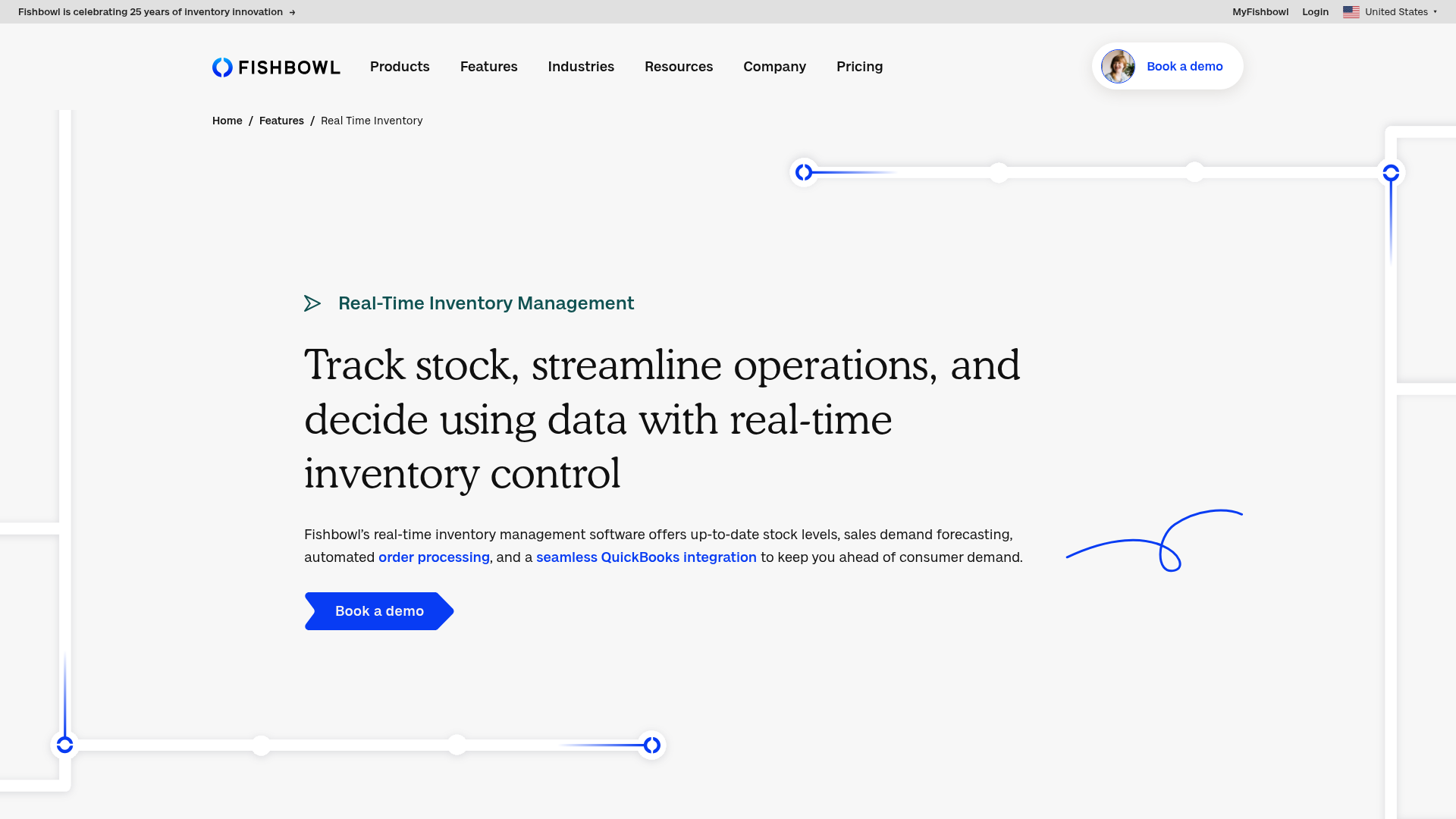
Fishbowl’s real-time inventory tracking page, which keeps stock counts current as items move. Source: Fishbowl (fishbowlinventory.com/features/real-time-inventory).
Key characteristics
- Real-time updates: every purchase, sale, transfer, or return immediately adjusts the stock record.
- Technology-driven: the system relies on connected tools like point-of-sale (POS) software, a barcode inventory system, and inventory management software.
- Continuous COGS: cost of goods sold and inventory valuation update after each transaction rather than at period end, in line with common inventory accounting methods.
- Supports cycle counting: because records stay live, teams can verify stock through small, ongoing inventory cycle counting.
- Accuracy and visibility: live records flag shrinkage and discrepancies fast, though clean master data still matters. A warehouse operations survey found only 57% of warehouse operators reported having 100% accurate SKU weights and dimensions in their inventory item master, down from 60% the prior year, per Supply Chain Management Review’s 2025 Warehouse/DC Operations Survey.
Example
Consider a specialty coffee roaster that scans each bag of beans at the register. The count drops by one instantly, and a purchase order triggers automatically at the reorder point.
Poor visibility carries real cost. Inventory distortion costs run high: the global retail industry loses $1.73 trillion annually due to inventory distortion, the cost of out-of-stocks and overstocks, according to IHL Group’s 2025 Inventory Distortion Study.
Real-time systems help close that gap. Extract Production, an oil and gas services company, reported saving $11 million in inventory costs with Fishbowl. The gains came after better visibility into demand and inventory cut stockouts. Fishbowl brings that live inventory control to QuickBooks and Xero users, delivering ERP-level control without an ERP project.
Related terms
- Periodic inventory system: updates stock records only after a scheduled physical count, not after each transaction.
- Periodic vs perpetual inventory accounting: compares how each approach records COGS and inventory value over a period.
- Types of inventory management: an overview of the main methods, including perpetual and periodic tracking.
FAQ
What is the difference between a perpetual and periodic inventory system?
A perpetual system updates records continuously after every transaction, while a periodic system updates only after a scheduled physical count.
Does a perpetual inventory system still need physical counts?
Yes. Businesses use periodic cycle counts to confirm the live records match what is physically on the shelf.
What businesses use perpetual inventory systems?
Companies with high transaction volumes or many SKUs, such as retailers, ecommerce sellers, and manufacturers, benefit most from real-time tracking.