
What is barcoding?
Barcoding replaces slow, error-prone manual data entry with a quick scan that pulls up an item’s stored details. Counting stock by hand and hand-keying part numbers eats time and invites mistakes, so a scan reads the code and updates the record in seconds. That speed is why the practice sits at the center of modern inventory and receiving work.
Operators lean on it at nearly every touchpoint: checking in a delivery, picking an order, moving stock between shelves, and running a cycle count. Each of those steps becomes a quick scan instead of a written note that someone has to type up later.
GS1 barcodes are scanned more than 10 billion times a day worldwide. Paired with an inventory scanning system, each scan can log where an item sits and how many units remain.
Key characteristics
- Machine-readable symbol: 1D or linear codes like a UPC (Universal Product Code) sit alongside 2D codes such as QR (quick response) and Data Matrix, which pack in more data per symbol.
- Encodes an identifier: the symbol stores a value that points to a stored record such as a stock-keeping unit (SKU), price, location, or lot, which is what good SKU management keeps organized.
- Needs hardware plus software: you pair a scanner or a camera phone with a label printer and inventory software to read the code and update records.
- Speeds capture and cuts error: a single scan takes the place of hand-keyed entry, so fewer typos slip into your data as items move through the warehouse.
- Standards-based: codes are governed globally by the global standards body GS1, which keeps formats consistent across retailers and suppliers.
Example
Retail barcodes are older than many of the businesses that rely on them. The first barcode scan in 1974 rang up a pack of Wrigley’s gum at a Marsh supermarket in Troy, Ohio.
Closer to today, Gillett Diesel Service, a car repair business, reached real-time inventory accuracy within about four months of scanning inventory with Fishbowl. Their result shows how a small team can implement a barcode system and trust the counts it produces.
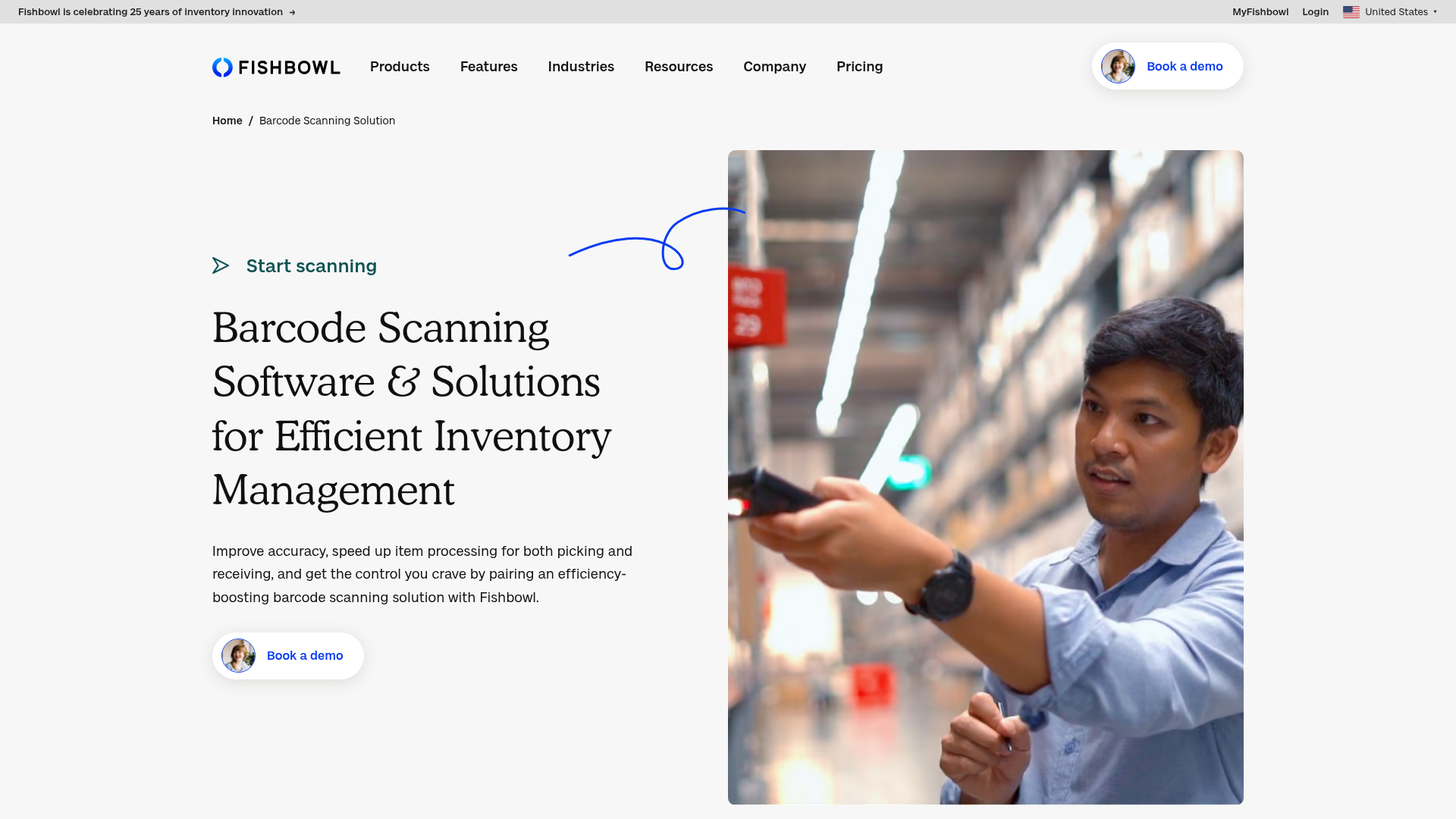
Fishbowl’s barcode scanning software pairs scanners with inventory software. Source: Fishbowl.
Related terms
- barcode software for manufacturers: how scanning ties into production and material tracking on the shop floor.
- small business barcode system: a starter setup for shops moving off spreadsheets and manual counts.
- UPC (Universal Product Code) tracking: the standard 1D retail barcode you see printed on consumer packaging.
FAQ
What is the difference between a barcode and a QR code? A QR code is one type of 2D barcode, and it stores more data than a traditional 1D code like a UPC.
Do I need special equipment to use barcodes? You need a scanner or a camera phone, a label printer, and inventory software, though many small businesses start with a phone app before buying dedicated hardware.
Is a barcode the same as a SKU? No. A SKU is your internal identifier for a product, while the barcode is the machine-readable symbol that lets you scan and pull up that item’s record.